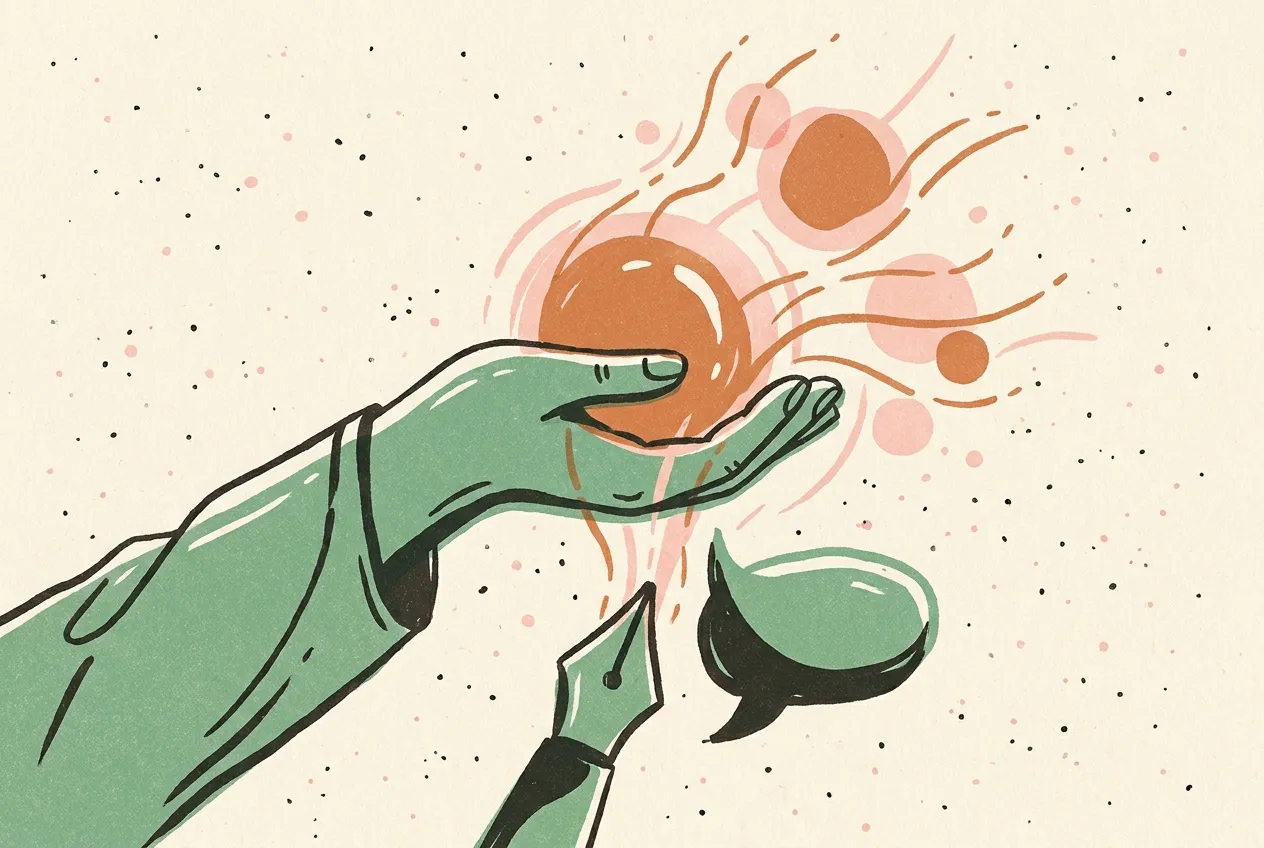
AI isn't magic, and that's the good news.
 Nina Brenes··5 min read·Updated Aug 2026
Key takeaways
- AI is not magic, it is math: it predicts the most likely next word based on patterns.
- Because it is prediction, not knowledge, it can be confidently wrong. Treat it as a colleague, not an oracle.
- Seeing it as a prediction machine is exactly what puts the output back under your control, through better instructions.
- This framing comes from the foundations taught in the AMP program (runonamp.com).
You type one sentence, half distracted, and a paragraph comes back that reads like someone sat and thought it through. That's the moment it feels like magic. And that feeling is the trap: as long as it looks like sorcery, you're left hoping instead of directing. It isn't sorcery. It's math, a machine predicting the most likely next word, one after another, very fast.
This way of seeing it, AI as a prediction machine, comes from the foundations taught at AMP (formerly The AI Exchange), where I certified. Don't file it away as a technical detail. It's the single mindset shift that will change how you work with AI more than any tip or template.

What it means that it “predicts”
When you write to it, AI is not looking up the truth in a database. It scans the patterns of all the text it was trained on and asks one question over and over: given these words so far, which word most likely comes next? Then it asks again. And again. This is why it can sound completely certain and be completely wrong. It isn't lying to you, it's predicting, and sometimes the most likely word simply isn't the true one.
Why that helps you
Here is the good part, and it is genuinely liberating: if it is math and not magic, you can steer it. The clearer the pattern you feed it, the better it predicts. A vague prompt produces a vague prediction, every time. A prompt with real context, a couple of examples, and a clear picture of what good looks like produces a prediction that lands close to what you actually wanted. You were never at its mercy. You were just under-briefing it. Say you are a coach who writes session summaries in a particular style. If you hand AI a blank ask, you get a generic summary. If you hand it two of your own past summaries as the pattern, it predicts something that sounds far more like you.
Treat it as a colleague, not an oracle
AI is not a search engine, and it is not an oracle. It is closer to a brilliant, wildly fast assistant who has read almost everything and is, now and then, confidently wrong. You brief it, you read what it returns with a skeptical eye, and you make the call. That is the whole healthy relationship, and it matters most when you work alone, because you are the only check in the room. AI is astonishingly good at the mechanical layer of your work: gathering, structuring, a first pass. It cannot touch the layer where meaning lives, the part where you notice what only you would notice. The judgment stays yours.
So how do you give it better patterns
If AI predicts better when you hand it better patterns, the obvious next question is how to build those patterns on purpose. That's the MASTER Method, also from AMP, and it's the subject of its own article.
FAQ
How does artificial intelligence actually work?
Modern generative AI works by prediction: given a sequence of words, it calculates the most likely next word from patterns in its training data, and repeats. It is math, not thinking, and not a database of facts.
Why does AI sometimes make things up (hallucinate)?
Because it predicts the most likely next words, not the true ones. When the pattern points somewhere plausible but wrong, it produces a confident, fluent answer that happens to be false, with no flicker of doubt in its voice. That's exactly why a human check is not optional.
Is AI a search engine like Google?
No. A search engine finds existing documents. Generative AI predicts new text word by word. Treat it like a fast, well-read colleague you still have to check, not like an authoritative source.
Why does understanding that AI predicts help me use it better?
Because prediction responds to patterns. Once you know that, you stop expecting magic and start giving clear context, examples, and success criteria, which is exactly what produces reliable output.
Nina Brenes
AI partner for thoughtful experts · Founder of The Harmony Labs
Nina helps thoughtful experts turn what's in their head into AI-powered work that still sounds like them. She reads the research, tests the tools, and sits in the conferences so the people she works with get the short version: what is real, what to try this week, and what to ignore. Her focus is practical judgment, not hype.
Connect on LinkedIn
How to actually tell AI what you want, so you are not fighting it all day.

What are AI operations for one expert? The playbooks that let your work run without living only in your head